I watched this video about happiness explained by a philosopher (@philosophyminis) and thought this was such a great topic to share on my blog. I only focused on the happiness part in this blog post, but the full video (30-minute long) contains more about love, money, and philosophy in our everyday lives.
You can do a quick read here, but if you have time, I encourage you to watch the full video and check out his Instagram page!
Jonny explained that there are three pillars of happiness.
First: Happiness is not measured by pleasure.
There’s no way we can satisfy all of our desires. So, to find happiness, we have to find it outside the notion of pleasure. Eudaimonia, translates as flourishing. Meaning that there are moments in life where we look back on our experiences and think they were really hard at the time but, actually, we were extremely happy — just like high school moments.
It’s a logical fallacy to say that happiness ≠ pleasure, meaning that suffering is a must. It makes us enjoy the suffering and see it as essential to reach happiness. But that’s not true.
Second: Moderation – Finding a Middle Way
Finding the balance between deficiency and excess. For example, finding courage is between cowardice and recklessness. Just like the yin-yang symbol, there is no white or black in life, but it’s all grey.
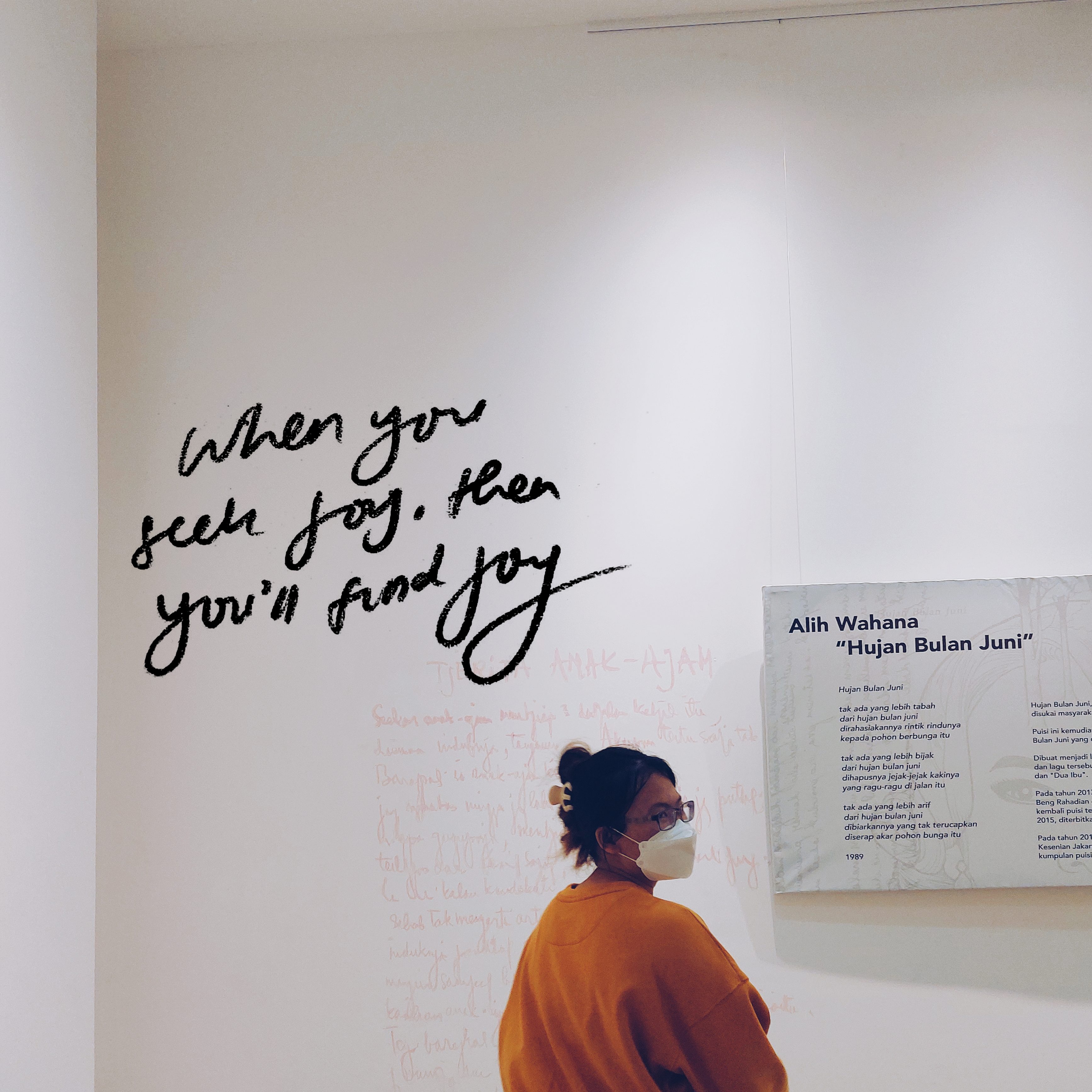
This second pillar reminds me of a wall display in the retreat house’s dining room I used to go to when I was in high school, where the point is that anything excessive also ends up being something negative.
Third: Virtue
“You can’t be truly and meaningfully happy unless you are also virtuous.”
But what’s the meaning of being virtuous? Defining good and bad – what’s right or wrong is very diverse in different cultures. But if we were to look from a broader perspective, certain trends would always emerge. These is the five universal virtues and vices that have always come up throughout time:
- Altruism vs. egoism. (charity or caring for other people)
- Kindness vs. cruelty (be good and kind to other people)
- Justice vs. injustice (retribution for wrongdoers)
- Wisdom vs. ignorance
- Humility vs. arrogance (intellectual and existential humility where there are things far more powerful than human being)
How can we implement those 3 pillars?
I think I have the perfect example for the first pillar. Lately I’ve been working on many projects both for work or personally. Physically I’m exhausted and stressed out but I’m deeply happy. I have the opportunity to grow and push through those challenges which I was never expected before. So even though there are hardships, but as a whole – I am deeply happy.
This reminds me of the book The Happiness Project by Gretchen Rubin. In that book, she sets certain goals for each month that she believes could make her happier—even though they require a lot more work than her usual life.
Applying moderation can be best seen in dieting. The types of ‘diets’ that most of us try are so extreme that they lead to failure. This leads us back to the second pillar, which is to eat in moderation—a degree of flexibility.
The last one has something to do with others or our surroundings. For instance, I always feel good sharing what I can share—as simple as answering questions to my friend, feeding stray cats, or preparing gift bags for the homeless. I always try to position myself on other people’s feet and think, ” What would I hope other people do to me?” and I do it to my best ability.
Are you unhappy?
These three pillars also serve as a diagnostic tool for us to identify our lives by asking the question: “Which of these three am I not meeting?” Maybe we confuse a hard patch of our lives with an unhappy life, or do we go too extreme on certain things, or is it possibly that we’re not being as good as we could be?
Let’s talk more about philosophy!
Jonny’s closing statement is really pique my interest to read philosphy books and also how he said to brought interesting conversation back into society, because life is too full of these boring and shallow conversations. Which distances ourselves from other people and ourselves because we don’t communicate on a deeper level – having important conversations.
This made me remember the discussion at the Ubud Writers and Readers Festival, when one of the panelists mentioned that we’re living in a bubble called an algorithm. The reality that we see could be very different because we refrain from interacting with each other on a deeper level. We’re connected because of digital technology, but we’re disconnected at the same time.
As much as I love being alone, I would always love to meet up with friends – or even strangers, and talk about things! Now I can better understand the reason behind that – the urge to be connected – and also to be understood and understand other people. Jonny gave a few examples of conversation topics, such as talking about God, our worries, our existential angst, or right and wrong.
(if you made it this far – this is an open invitation for you! Let’s connect and talk about those things!)
On the other note, distancing from ourselves means not understanding what really matters and what motivates us. I couldn’t agree more! Journaling has been such a great way for me to get to know myself better and dissect my mind. I went through a dark season back in 2021, during the pandemic, where my life was actually great but I feel the lack of depth in it, so that’s where I started to journal more intentionally. And I must say, doing it day to day is a hassle especially when I came home late, but the experience as a whole is bringing me happiness.
 VERONICAKUDO
Leave a comment